This photo taken on the 26th October at 9:28 PM (GMT+8), while passing over the Second Link Bridge toward the Tuas Checkpoint in a taxi that had picked me up in Iskandar Puteri, en route to my rented apartment in Jurong. This moment marked the final day of my 14th week in Singapore, with only a few days remaining before my scheduled return to Malta.
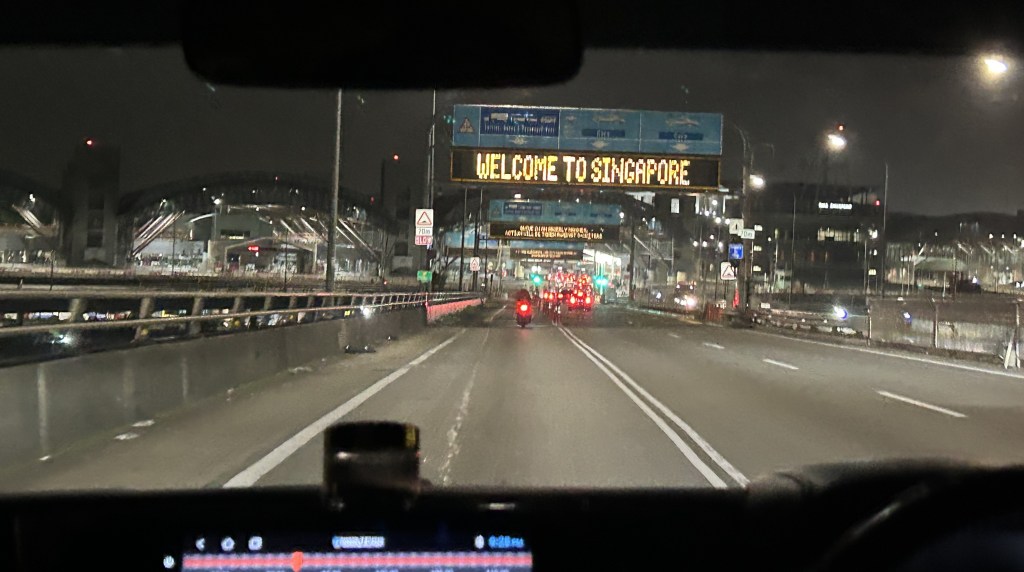
I will probably remember the feelings in me at that instant for the rest of my life. It was a mix of satisfaction, hope and most of all vindication. The Singapore experience was indeed the most important feat of my life.
Eleven years after the pivotal decision to realign my life’s trajectory toward genuine passion rather than chasing illusions, I find myself midway through my doctoral studies at the University of Malta. My academic journey had already been adorned with significant milestones: an undergrad in Social Policy and a Master’s in Sociology, which delved into the complexities of social class and mobility within Malta, achieved with Distinction during the throes of a global pandemic.
Fortune was on my side when assigned with my doctoral supervisor, one of the foremost scholars in Sociology and island studies, Prof. Godfrey Baldacchino. He is not merely an academic mentor but also a beacon of humanity and wisdom. Through his generosity in sharing his invaluable network, I was introduced to Prof. Alan Chong, a distinguished Singaporean academic at the S. Rajaratnam School of International Studies (RSIS) at the Nanyang Technological University (NTU), and former research assistant to none other than Lee Kuan Yew, Singapore’s founding Prime Minister. Thanks to this connection, I attained Visiting Associate status at RSIS, a development that significantly eased my immersion into Singaporean academia and society. Prof. Chong’s instrumental guidance extended beyond administrative matters – his connections with leading political science scholars and his provision of essential resources were pivotal in deepening my understanding of Singapore’s intricate social and political fabric. Together, their unwavering support – remote and on the ground – proved indispensable for my Southeast Asian stay, a transformative experience that reshaped my academic and personal perspective, making every sacrifice worthwhile.
The sacrifices, however, were enormous. It was not merely the material cost of such an endeavour but also the emotional toll. Leaving behind my family for 100 days was a hard choice, which also necessitated me to part from my six-month-old daughter. While the psychological effect of separation was remarkable for me, I also appreciate how challenging it was for my family back home to manage without my presence and support. This journey was not mine alone; it was borne collectively.
Singapore offered a fascinating, albeit challenging, chapter in my life. The culture shock was stark and unexpected. Southeast Asia is no parallel to Europe, and Singapore, unique in its own right, is neither a typical Asian state nor a European city. It is a vibrant confluence of diverse Asian cultures and ethnicities, a dynamic and volatile society whose complexities elude superficial understanding. While my pre-departure readings had prepared me knowledgeably, the lived experience revealed nuanced layers that theory alone could never illuminate. This immersion not only expanded my academic perspective but also forced me to confront personal struggles, assess my resilience, and test my abilities within one of the world’s most competitive academic ecosystems. Singapore became an infinite source of inspiration, knowledge, and opportunity, challenging me to decipher its ethos – the ‘Singaporean way’ – with a level of perseverance I hope my doctoral work reflects.
A highlight towards the end of my Southeast Asian expedition was attending a conference on the Digital Rights Programme for Civil Society Organisations, hosted by the Asia Centre in Johor Bahru, Malaysia. Beyond the intellectual stimulation of the conference itself, this gathering became a fertile ground for forging connections with academics and activists from across South Asia, including Nepal, India, Sri Lanka, Bangladesh, Thailand, Cambodia, Malaysia, and Sarawak. Discussions around my research interests, particularly community resilience, were met with enthusiasm, yielding promising prospects for future collaborations.
My Southeast Asia experience was nothing short of an awakening. It crushed the boundaries of my previously insular Maltese context and opened my eyes to the vast potential of engaging with global narratives.
The dose of fresh perspectives and newfound eagerness has not only strengthened my research ambitions but also stirred a profound curiosity for uncharted geographical territories, both academic and personal.
The road has been arduous, the sacrifices profound, yet the rewards – intellectual, emotional, and experiential – have surpassed anything I could have anticipated.
This journey has profoundly shaped me, fostering a deep sensitivity to the intricate dynamics and complexities of humanity, not only across Europe but also in other parts of the world I have overlooked until now. It has sparked an intense interest to delve further into and comprehend the lived realities within diverse socio-political contexts of contemporary communities.
 Islander Perspective
Leave a comment